Guide · Plumbing basics
How to shut off the water to your house
Knowing where your main water shutoff is in your Greeley, CO home, and that it works, turns a burst pipe from a flood into a mess. It takes a few minutes to find and test it now, and it is the first move in almost every plumbing emergency.
Reviewed October 2026
The short version
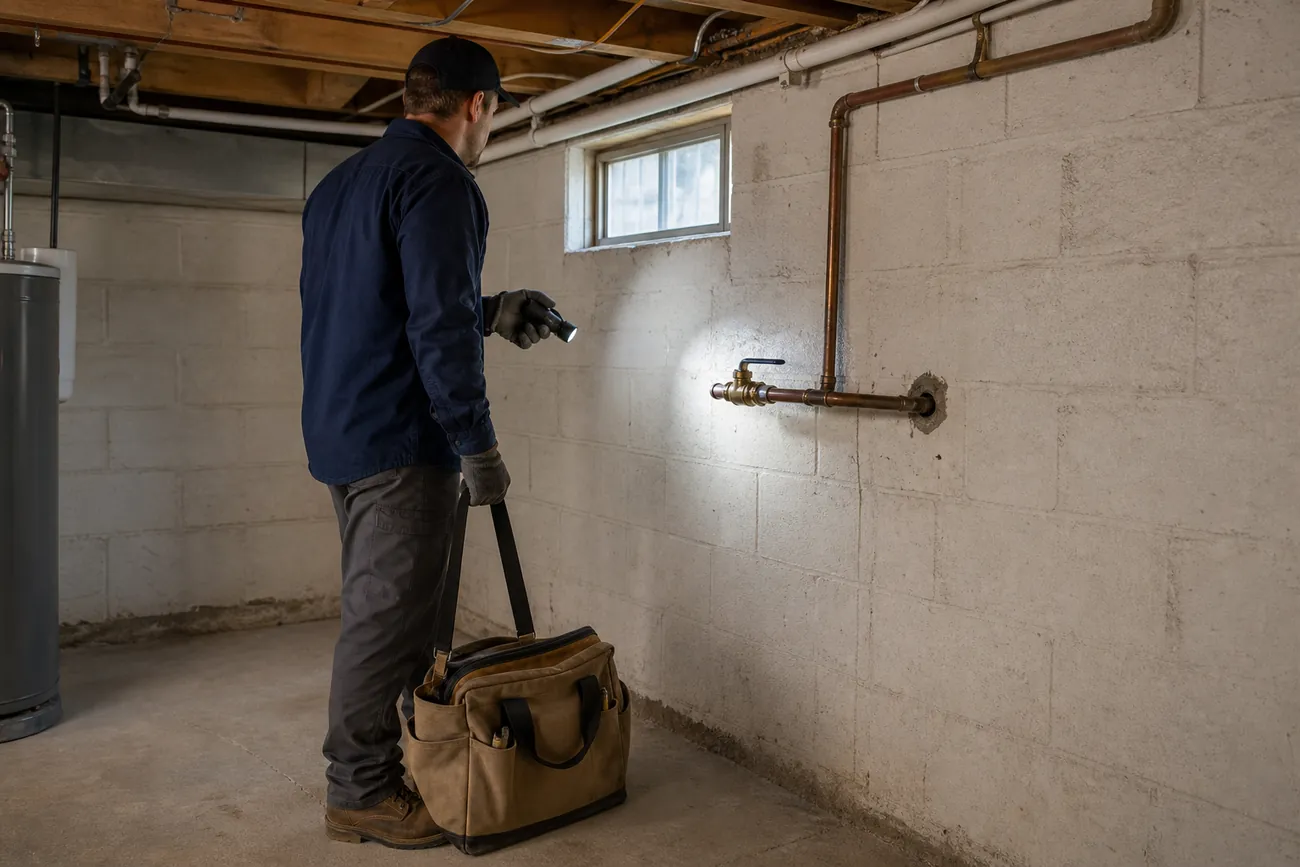
- The main valve is usually where the water line enters the house, often near the water heater, in a basement, utility room or crawl space.
- A lever across the pipe, or a wheel turned clockwise, closes it.
- Then open the lowest faucet to drain the pipes.
Water you cannot stop is an emergency. Emergency steps
- 1Main shutoff valve
- 2Line enters the house
- 3Branch to the rest of the house
Find the main water shutoff in your Greeley home
Follow the water line. The main shutoff is on the pipe where water first enters the house, before it splits off to the rest of the plumbing.
- A
Where the line comes through the wall or floor
Look for a pipe, often copper, rising or entering where the foundation meets the floor.
- B
Near the water heater or the washing machine
The City of Greeley's water department notes that the master shutoff may be near either.
- C
A utility room, closet or garage
In homes without a basement, the valve may be in a utility room, a hall closet or an attached garage wall.
- D
A crawl space
It may be in the crawl space near the access door. Look before you need it, with a flashlight, not during a leak.
Know your valve
The valve type decides how it closes. Two are common on a main line, and a third is the small one under sinks and behind toilets.
Whatever the type, turn gently. A valve that has not moved in years can stick or break.
- AGate valve. A round wheel. Turn it clockwise, several full turns, until it stops.
- BBall valve. A lever. A quarter turn: lever along the pipe is open, lever across the pipe is closed.
- CFixture stop. A small oval or lever handle at a sink or toilet. Turn it clockwise.
Shut it off, step by step
The order matters a little: close the supply first, then let the pipes drain.
Close the main valve slowly
Turn it until it stops, or move the lever across the pipe. Closing slowly is easier on the pipes than slamming a valve shut.
Open the lowest faucet
Open a cold-water tap at the lowest level of the house, then one upstairs, so the water left in the pipes drains out.
Check that the water has stopped
The faucets should slow to a trickle and stop. If water keeps running at full strength, the valve is not closing fully.
Leave the water heater alone
Do not drain it unless it is the thing that is leaking. If the tank has been drained, switch off its power before turning the water back on, because an electric element can be damaged when it heats an empty tank.
Fixture shutoffs: the small valves
Most fixtures have their own shutoff, so a leak at one does not mean shutting off the whole house. Learn these too.
- ToiletA small valve low on the wall or floor behind the bowl. Clockwise closes it.
- Sink and faucetTwo small valves, hot and cold, under the sink.
- Washing machineTwo valves on the wall behind it. Some have a lever.
- Dishwasher and ice makerUsually a valve under the kitchen sink or behind the appliance.
- Water heaterA valve on the cold-water pipe feeding the top of the tank.
- Outdoor faucetOften has its own valve inside the house. Winter care for outdoor faucets
- 1Main shutoff (inside)
- 2Water meter
- 3Curb stop
The valves outside: leave them to the city
Between the street and your house there are usually two more valves: a curb stop, and the water meter. The City of Greeley describes the water line this way: the city owns the line from the public main to the property line, and the homeowner is responsible for the section from the property line into the house, which may include the curb stop and the water meter.
That describes who is responsible for the pipe. It does not say you may operate those valves. Do not force the curb stop or turn the meter valve; ask the city first. The City of Greeley's Water and Sewer department is the one to ask.
The interior main is the one to use. It is on your side of the wall and is meant for exactly this. Where the property line falls on your lot is something this guide cannot tell you.
Test it now, before you need it
A valve that has not moved in years may stick or leak at the stem when you finally need it. Check it on a calm day.
Do once, today
- Find the main valve and take a photo of where it is
- Tie on a tag or write the location on the wall near it
- Close it and open it again, gently and fully
- Check the stem and the pipe around it for drips
- Show everyone in the house, including anyone who is home alone
Do not
- Force a stuck valve with a long pipe on the handle
- Turn the valve fast when closing it
- Leave the valve half open
- Stack boxes in front of it
If it will not close, or it leaks
An old valve may not close fully, or it may drip at the stem once you turn it. Neither is a reason to force it.
- Try the fixture shutoff for the part that is leaking, if there is one. A small leak at a fixture can usually wait for a scheduled visit once that valve is closed, while a leak with no valve to close is a reason to shut the main.
- If the main will not close, or water still runs at full strength, treat it as water you cannot stop. Emergency steps
- A valve that weeps at the stem or will not turn can usually be replaced. Replacing one means working on the line that feeds the whole house, which is plumber's work.
Need a plumber for a stuck valve or a leak?
Say which valve it is and what it is doing.
Turn the water back on
Do it slowly. Water returning fast can bang the pipes and push air through the lines.
Close the faucets you opened
Everything should be off before the water comes back.
Open the main valve slowly
Open it fully, but gradually. Listen for water running where it should not be.
Let the air out
Open a faucet at the highest level, then work down, until each runs steadily with no sputtering.
Check for leaks
Look at the valve, the repaired area and the pipes you can see. Check again after an hour. If the water heater was drained, make sure the tank is full before power goes back on.
Common questions
Should I shut off the water when I go on vacation?
It is a common precaution, especially in winter, since a leak or a frozen pipe has no one to notice it. For a long absence, a plumber can advise on draining the lines too. More on frozen pipes
Do I need to shut off the water heater too?
Not for a short shutoff. Leave it alone unless it is the part that is leaking. If the tank gets drained, switch its power off first.
What if the shutoff is a wheel that will not turn?
Do not force it. Try the fixture shutoff for the leaking part, and call a plumber for the valve.
Can I use the shutoff valve in the yard?
Leave the curb stop and the meter to the city. The City of Greeley describes your section of the line as possibly including them, but whether you may operate them is a question for the city's water department.
How often should I test the main valve?
Once or twice a year is a reasonable habit, and again if you have not touched it for a long time.
Related pages
- Burst pipe repairAfter the water is off: where the pipe failed and how it is repaired.
- Emergency plumberTriage for water, sewage, gas and heater problems.
- Frozen pipesThawing safely and preventing a split.
- Water heater leakingWhen the leak is at the tank.
- Leak detectionFor leaks you cannot see.
- Who repairs sewer and water linesThe city's side and yours.