Frozen pipes · Greeley, CO

Frozen pipes in Greeley, CO: why they split and how to stop a burst

The ice blocks the water, but the damage comes when the pipe splits, often as the ice melts. Know where your main shutoff is, and call now to connect with a local plumber for help with frozen pipes in Greeley, CO as soon as a pipe stops delivering water, because a split can sit hidden until the thaw and then flood the wall it is in.

Local plumbers in Greeley • Request an upfront written estimate • No obligation to hire.

UNHEATED 1 2 3 4
Fig. 1 Where pipes freeze
  1. 1Outside wall
  2. 2Unheated garage or crawl space
  3. 3Attic
  4. 4Outdoor faucet
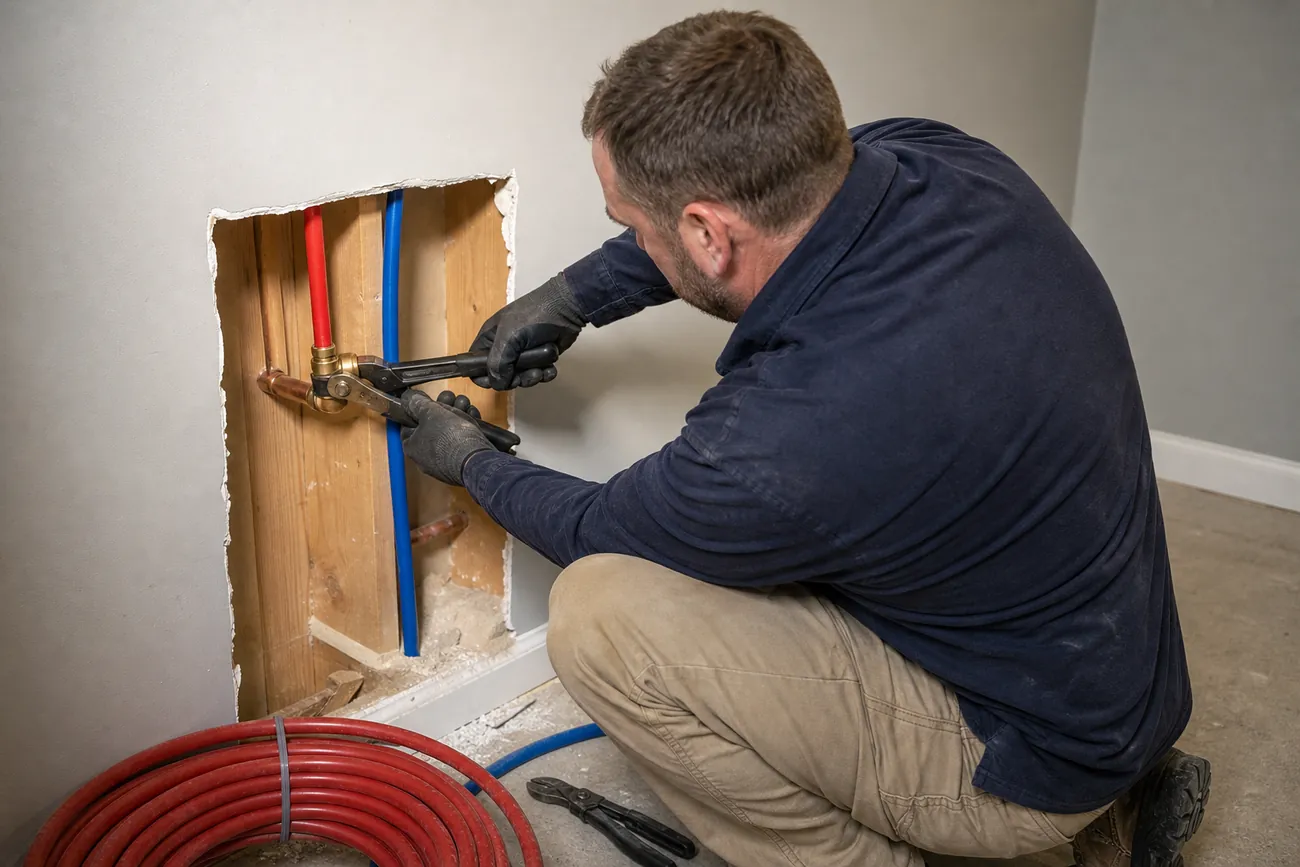
A plumber crouched at a square opening cut in a basement wall, using a crimping tool on a brass fitting that joins red plastic water pipe to a copper stub, with blue pipe beside it and a coil of red tubing on the floor.

Where are you?

Frozen pipes in Greeley: which of these is happening?

Frozen pipes go from a risk to a repair in three stages. Each has a different first move.

Cold snap coming

Not frozen yet

The forecast is bad, or a part of the house is hard to keep warm. A few steps tonight lower the risk.

Prevention steps

Frozen, not leaking

No water, or a trickle

A faucet is dry or slow and there is no sign of water where it should not be. The pipe may already be split behind the ice.

Why the thaw is the risk

Frozen and leaking

Water where it should not be

A split pipe leaks as the ice melts. Shut off the main first; the repair comes after.

Burst pipe steps

How to shut off the water

CLOSED FAUCET ICE SPLIT IN THE TRAPPED WATER
Fig. 2 Where a frozen pipe splits Positions vary by house.

Frozen now

Concealed freeze expansion and thaw ruptures

Water expands by roughly nine percent as it turns to ice, and a closed pipe has nowhere to put the extra volume. The pipe that freezes is not always the pipe that fails, and the failure is often not noticed until the ice melts.

  1. Where the pressure builds

    As ice grows along a pipe it squeezes the water still liquid between the ice and a closed faucet or valve. That trapped water has no way out, so its pressure climbs until the weakest point in the pipe wall gives way, usually as a thin lengthwise split that can start no wider than a hairline.

  2. Why it leaks at the thaw

    While the ice stays in place it plugs the split. As it melts, the line pressure behind it reaches the opening and pours into the wall cavity, the ceiling or the floor below. A split pipe often shows no water for hours, then releases the full supply into a space nobody is looking at.

  3. Why a thaw is not a do-it-yourself job

    A frozen pipe in a wall, a crawl space or under a slab hides the stretch that matters: where the ice ends, where the split is, and whether the supply is open behind it. Applying heat without knowing those three things risks scorching the pipe, wiring and framing around it, and still leaves the first sign of the split to be water coming through drywall.

  4. What a plumber does instead

    A plumber locates the frozen stretch, closes and drains the affected branch so there is nothing to flood, thaws it under control with the shutoff within reach, and then checks the whole length for splits and fittings that have been pushed apart. Damaged sections are replaced, and the cause is addressed with insulation, air sealing or relocating the line so it does not freeze again.

Call a plumber if

  • The frozen stretch is inside a wall, a ceiling or under the floor and you cannot reach it
  • No faucet in the house has water, which can point to the main supply line
  • The pipe is bulging, cracked or leaking
  • Careful warming has not restored the flow
  • You cannot tell where the freeze is

What not to do

  • Use a torch, lighter, camp stove or any open flame
  • Leave a heater or heat gun running unattended near the pipe
  • Stand in water while using electric heating tools
  • Assume a thawed pipe is undamaged; check it for leaks

Cannot reach the freeze, or the pipe has split? Call now to connect with a local plumber for frozen pipe help in Greeley.

Call (970) 633-4799

Before it freezes

How to keep pipes from freezing

Most freezes happen in a few predictable places: outside walls, unheated spaces and outdoor connections. These steps are the usual defense.

Tonight

When a hard freeze is forecast.

  • Open the cabinet doors under sinks on outside walls so house warmth reaches the pipes
  • Let a small, steady stream of water run from a kitchen faucet on nights the forecast is below 20 degrees, as the City of Greeley's water department suggests
  • Keep the heat on and the garage door closed
  • Know where the main shutoff is. Finding it

This fall

Before the weather turns.

  • Disconnect and drain outdoor hoses, and shut off outdoor water connections, irrigation included
  • Insulate pipes and faucets in unheated spaces such as a garage or crawl space
  • Seal cracks, vents and access doors that let cold air in
  • Make sure everyone in the house knows where the main shutoff is

If the house will sit empty

A vacant house has no one to notice a leak.

  • Keep the heat on, set low rather than off
  • Have someone look in during very cold weather
  • For a long absence, consider shutting off the main and draining the pipes; a plumber can advise

Outdoor faucets

Outdoor faucets and irrigation

A hose left on, or water left in a faucet, is one of the most common ways a house ends up with a split pipe in the wall.

Hose faucets, in three steps

Standard and frost-free faucets both need attention.

  1. Before the first hard freeze

    Disconnect the hose and drain it. If there is a shutoff valve inside the house for that faucet, close it and open the outdoor faucet to drain the pipe.

  2. Frost-free faucets

    They have a long stem so the valve seals inside the warm part of the wall. A hose left connected can still trap water and split the pipe behind the wall.

  3. In spring

    Turn the faucet on and watch the wall, ceiling or basement near it for a drip or spray. A split inside a wall can stay hidden until the water is back on.

If it has split

A frozen pipe can split without a sound

The leak often shows up as the ice melts, sometimes hours after the thaw begins.

If water appears, close the main first. The repair can wait for the plumber.

Burst pipe repair: the steps and what a repair involves · How to shut off the water to your house

FAQ

Frozen pipes: common questions

How do I know if a pipe is frozen?

A faucet that gives no water or only a trickle in freezing weather is the usual sign. Frost on an exposed pipe, or a pipe that feels very cold, points to where.

Should I let my faucets drip in freezing weather?

The City of Greeley's water department suggests running a small, steady stream from a kitchen faucet on nights forecast to fall below 20 degrees. Moving water is harder to freeze.

Will a frozen pipe always burst?

No, but it can, and the split often only leaks once the ice melts. That is why a pipe that has thawed should be checked along its length.

What if no faucet in the house has water?

The freeze may be in the main supply line rather than one branch. That is hard to reach, and a freeze on the main supply can split a pipe where it enters the house, so it is a call to a plumber. Know where your main shutoff is

Can I thaw a pipe that is inside a wall?

Not safely by yourself. A pipe in a wall can be split behind the ice without any sign, and heat applied blind can damage the wiring and framing around it. Keep the room warm, close the main shutoff if you see any water, and call for an immediate evaluation. Never use a torch or open flame near a wall.

Do frost-free outdoor faucets need to be winterized?

They need less, but the hose must still come off. A hose left connected can hold water in the faucet and split the pipe behind the wall.

What should I do while waiting for a plumber?

Find the main shutoff and be ready to close it. Keep the heat on and open cabinet doors under sinks on outside walls so room air reaches the pipes. If the pipe is bulging, cracked or leaking, or water appears on a wall or ceiling, shut off the main water supply and tell the plumber when you call. Do not use a torch or open flame.

Call about the frozen pipe

Say which faucets are affected and whether any water is leaking.

Reviewed October 2026

Call (970) 633-4799