Guide · Drains and sewer
Sewer smell in the house: where it comes from, and when it is gas
Rotten eggs? Treat it as gas first.
If it is strong, spreading, or you cannot tell what it is: leave immediately and move a safe distance. Do not use anything that can spark, such as a light switch. Call 911 once you are clear, then your gas utility.
A rotten-egg smell in a Greeley, CO home can come from a dry drain trap, a worn toilet seal, a blocked vent or a damaged sewer line. It can also be natural gas. This guide starts with the gas question, then helps you find where the smell is strongest.
Faint, and only at one drain or toilet? Then read on.
Reviewed October 2026
Sewer smell in the house: gas or drains? Settle that first
Both are described as smelling like rotten eggs, so the smell alone may not tell you which one you have.
Sewer gas
- Hydrogen sulfide is a gas that smells like rotten eggs. It is associated with municipal sewers and sewage treatment plants.
- At high concentrations, a person might lose the ability to smell it and wrongly think it is gone. The nose is not a reliable test.
- This guide cannot say what is in the air at your home.
Natural gas
- Natural gas has no smell of its own. Odorants are added when it enters local distribution pipelines, to give it a pungent smell similar to rotten eggs.
- A smell near a gas appliance or gas line is a gas question first.
If you cannot tell which it is, treat it as gas. Leave, move a safe distance, call 911 once you are clear, then your gas utility. A plumber is for the drains, after the area has been made safe.
- 1Floor drain
- 2Toilet base
- 3Sink drain
- 4Roof vent
- 5Cleanout cap
- 6Water heater
Where is the smell strongest?
Once gas is ruled out, walk through the house and note where the smell is strongest. The numbers match the drawing.
- 1
A floor drain you rarely use
Its trap may have dried out, so the water seal no longer blocks the smell.
- 2
Around the toilet base
The seal between the toilet and the drain, the wax ring, may be failing.
- 3
One sink, tub or shower drain
That fixture's trap may be dry or dirty. Other drains smell fine.
- 4
Near the vent pipe on the roof
A blocked or damaged vent may be the cause. Look from the ground; do not climb up.
- 5
Near the cleanout
A loose, cracked or missing cap may let the smell out.
- 6
Only from the hot water
Note it, and say so if you call a plumber. Near a gas water heater, treat it as gas first.
Smell in every room, or with slow drains, gurgling or sewage coming up, may be the sewer line itself. See the last cause below.
How a trap keeps the smell out
Every drain has a trap, a curved section of pipe that holds a little water. That water is a seal: it stops air from the drain pipe coming up into the room.
If a drain goes unused, the water can evaporate and the seal goes with it. A basement floor drain or a spare bathroom is where a trap is likelier to dry out. Running water down the drain refills the seal.
If the smell comes back soon after you refill a trap, the cause may be somewhere else, such as a vent.
- AThe water seal. Water in the bend blocks air from the drain pipe.
- BThe dried-out trap. With the water gone, air from the drain pipe can pass into the room.
Causes, and what a plumber finds
For each one: what it is, how it fails and what that means for the house, and what a plumber does about it.
-
A dry trapFig. 1, spots 1 and 3
The water seal has evaporated, so air from the drain pipe can pass.
What it means: a trap is the water seal between the room and the sewer gas in the drain pipe. A seal that has evaporated is a sign the fixture has gone unused, but a seal that keeps being lost is a sign of siphoning from a blocked or undersized vent, or of a leak at the trap.
Plumber: a trap that dries out again quickly, or a smell that returns after you run water, may point to a vent or drain problem. A drain that smells and is also slow is a drain cleaning question.
-
A failing wax ringFig. 1, spot 2
A wax ring seals the toilet to the drain pipe below it. If it fails, smell can escape at the base.
What it means: a smell strongest at the toilet base points to a seal that no longer holds. The same gap lets sewage-laden moisture seep under the toilet during use, where it soaks the flooring and subfloor and feeds rot and mold, so a wax-ring smell is worth acting on before the floor tells you why.
Plumber: replacing the ring means lifting the toilet, and many people leave that to a plumber.
-
A vent problemFig. 1, spot 4
Vent pipes let air into the drain system and let gas out above the roof. A blocked or damaged vent can make drains gurgle and slow down, and can let traps lose their water.
What it means: a vent that is blocked by a nest, ice or debris, or cracked in the attic, starves the drain system of air. Water then drags the trap seals out of the fixtures as it flows, which lets sewer gas into the house. A plumber checks the vent from the roof or attic, where it is safe to work.
Plumber: clearing or repairing a vent.
-
A loose cleanout capFig. 1, spot 5
The cap on the cleanout seals the opening into the sewer line.
What it means: the cleanout is a direct opening into the sewer line, so a missing or cracked cap is a direct path for odor and, if the line backs up, for sewage. Do not open it, especially if drains are slow or backing up: the wastewater held behind the cap can come out.
Plumber: a missing or cracked cap, or any work at the cleanout.
-
A damaged or blocked sewer lineNot shown in Fig. 1
A smell in several places together with slow drains, gurgling or sewage coming up may point to a problem with the sewer line itself.
What it means: a cracked, offset or root-penetrated line leaks sewage into the soil as well as odor into the house, and a belly in the line holds standing wastewater that smells. Note which fixtures are affected and in what order, and tell the plumber. Slow drain or main sewer line clog? How to tell
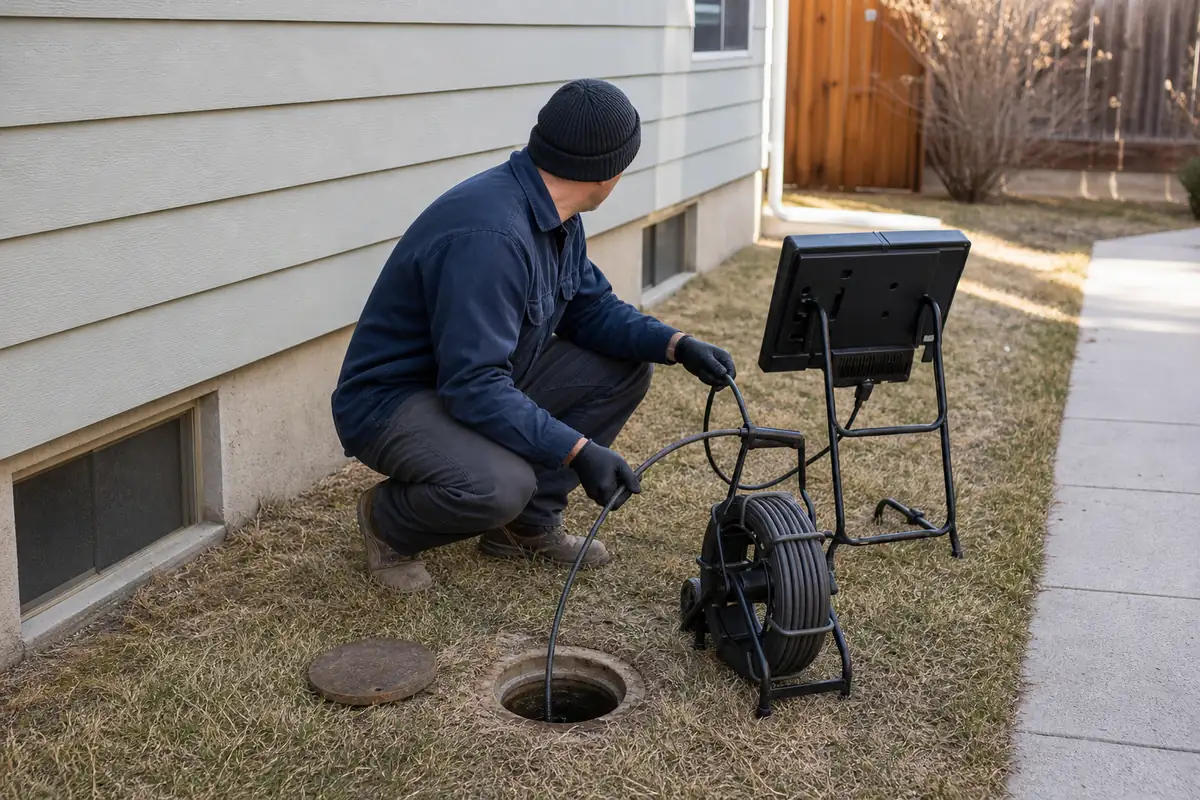
Plumber: a camera can show whether the line is damaged. Sewer camera inspection If sewage is coming up, see sewer backup.
When to call a plumber
Gas comes first: if the smell may be gas, leave and call 911 from a safe distance, then your gas utility, before anyone is called about the drains. After that, call a plumber when the smell comes back after you refill a trap, when it is at the toilet base or the cleanout, when it is in several rooms, or when drains are also slow or gurgling.
Smell not going away?
Say where it is strongest and whether any drains are slow or gurgling. A plumber can then plan a smoke test or a camera inspection that finds the path.
Common questions
Is a sewer smell dangerous?
This guide cannot say what is in the air at your home, and the nose is not a reliable test: at high concentrations, hydrogen sulfide can dull the sense of smell. If the smell is strong or unexplained, treat it as gas. Leave, call 911 once you are clear, then your gas utility.
Why does a floor drain I never use smell?
Its trap may have dried out. The water that seals the trap evaporates when a drain goes unused, and air from the drain pipe can then pass. Running water down the drain refills the seal.
Why does only one drain smell?
That fixture's own trap may be dry or dirty. If the drain is also slow, it may need cleaning. Drain cleaning
Can a smell mean a broken sewer line?
It can. A smell in several places, together with slow drains, gurgling or sewage coming up, may point to the line itself. A camera can show whether it is damaged. Sewer camera inspection
Should I call a plumber or the gas company?
If the smell may be gas, leave, call 911 once you are clear, then your gas utility. A plumber is for the drains, after the area has been made safe.
Why do I only smell it on hot water?
This guide cannot say why. Note when it happens, such as only when hot water runs, and tell the plumber, who can check. If the smell is near a gas water heater, treat it as gas first.
What should I do while waiting for a plumber?
If the smell may be gas, leave first and call 911 from a safe distance, then your gas utility. If it is a drain smell, note where it is strongest, whether it is worse after certain fixtures drain, and whether any drain is slow, and leave the cleanout cap closed.
Related pages
- Slow drain or main sewer line clog?A four-question test to tell one fixture from the main line.
- Drain cleaningSlow or stopped sinks, tubs and floor drains.
- Sewer camera inspectionSeeing inside the line.
- Sewer backupSewage coming up, and whose line it is.