Guide · Drains and sewer
Slow drain or main sewer line clog? How to tell
A slow sink and a blocked main line in a Greeley, CO home can look alike at first, but they are different jobs. Watching which fixtures are affected, and in what order, usually tells you which one you have before anyone is called.
Reviewed October 2026
The short version
- One fixture slow: the clog is in that fixture's own drain.
- Several fixtures at once, especially the lowest ones: the main line.
- Sewage coming up in the house: treat it as a sewer backup.
Sewage in the house now? Sewer backup steps
- AA blockage in one branch. Only that branch is affected.
- BA blockage in the main drain. Every branch backs up, the lowest drains first.
- CThe cleanout. A capped opening into the main drain.
- DThe lowest drain. Often a basement floor drain, tub or shower.
Slow drain or main line clog in Greeley: how your drains are connected
Each fixture drains into a branch line, and the branches join one main drain that carries everything out to the sewer.
Where a blockage sits decides how many fixtures notice it. A clog in a single fixture's drain affects that fixture. A clog in the main drain affects every branch upstream of it, and wastewater with nowhere to go comes up at the lowest opening first. That is why the basement drain is usually the first to show a main-line problem.
The four-question test
Run through these in order. You do not need tools; you need a few minutes and to watch.
-
Is it one fixture, or more than one?
Just oneThe clog is in that fixture's own drain or trap. Skip to what to try.
More than oneGo on to question 2. It points beyond a single fixture.
-
Which fixtures, and where are they?
Same part of the houseA bathroom's sink, tub and toilet and nothing else points to the branch line they share.
All over, or the lowest firstA basement drain or ground-floor tub that is slow or filling points to the main line.
-
Does using one fixture affect another?
Nothing reactsFlush a toilet, run the washer and watch the nearest drain. If no other drain bubbles or rises, it is more likely a branch.
Bubbling or rising waterA toilet that gurgles when the washer drains, or a floor drain that fills when a toilet flushes, points to the main line.
-
Did it come on gradually or all at once?
Over weeksBuild-up of grease, hair or soap, usually in a single drain or branch.
All at once, everywhereA blockage in the main line, or damage to it, is likelier.
What your answers mean
Add the answers up and pick the closest match. Each one points to a different page and a different size of job.
-
One fixtureSlow or stopped
A clog in that fixture's drain or trap, which a plumber clears from the fixture. A toilet has its own page.
-
One branchSeveral fixtures, same area
The branch line they share is blocked or narrowed. It is reached from the fixtures or the cleanout.
-
The main lineMany fixtures, lowest first
The drain that all branches join is blocked. A plumber reaches it through the cleanout. If it keeps coming back, a camera inspection can show why.
-
Sewage coming upBacking up now
Stop using water and keep clear of the affected area. This is a sewer backup, and the first question is whose line it is.
Gurgling, bubbling and smells
Gurgling is air being pushed or pulled through the water in a trap. It is an early warning, and it matters more when it happens in a different fixture from the one you are using.
- A toilet that gurgles when a sink or the washer drains points to a partly blocked line or a blocked vent.
- Gurgling in one fixture only, along with a slow drain, usually points to that fixture's own drain.
- A sewer smell with no slow drains has other causes, such as a dry trap. Sewer smell in the house
Fixture blockage vs. main lateral failure: recognizing structural restrictions
The answers above separate a blockage at one fixture from a restriction in the line behind it. The difference matters because they fail in different ways and are fixed in different ways.
Signs of a fixture-level blockage
- One sink, tub or shower is slow and every other drain runs normally
- Hair, soap or grease has collected in the stopper, the trap or the first length of the branch
- The slowdown came on over weeks and has not spread to a second fixture
Signs of a lateral restriction, and what to avoid
- Chemical drain openers, especially with several drains affected
- Running water over and over to see if it clears
- Opening the cleanout while the line is backed up
- Pouring grease down the drain once it clears
A lateral restriction is a narrowing or a low point in the pipe that carries the whole house's wastewater to the sewer. Roots enter the joints of older clay (terracotta) pipe and build into a mat that catches paper. A belly, a sagging stretch of plastic pipe over settled ground, holds a pool of water and lets solids drop out of the flow. Grease and mineral scale thicken the wall until a normal load no longer passes. Each one is made worse by pouring more water and chemicals into the same pipe.
A plumber separates the cases by how the cable behaves on a drain machine, and then by a color fiber-optic camera passed through the cleanout, which shows roots, offset joints, a belly or scale directly. Waiting has a price: a restricted lateral does not clear itself, and when it finally stops it backs wastewater up at the lowest opening in the house. Sewage on a basement floor soaks drywall, framing and the subfloor, brings a contamination risk with it, and invites mold within days.
The cleanout: know where it is
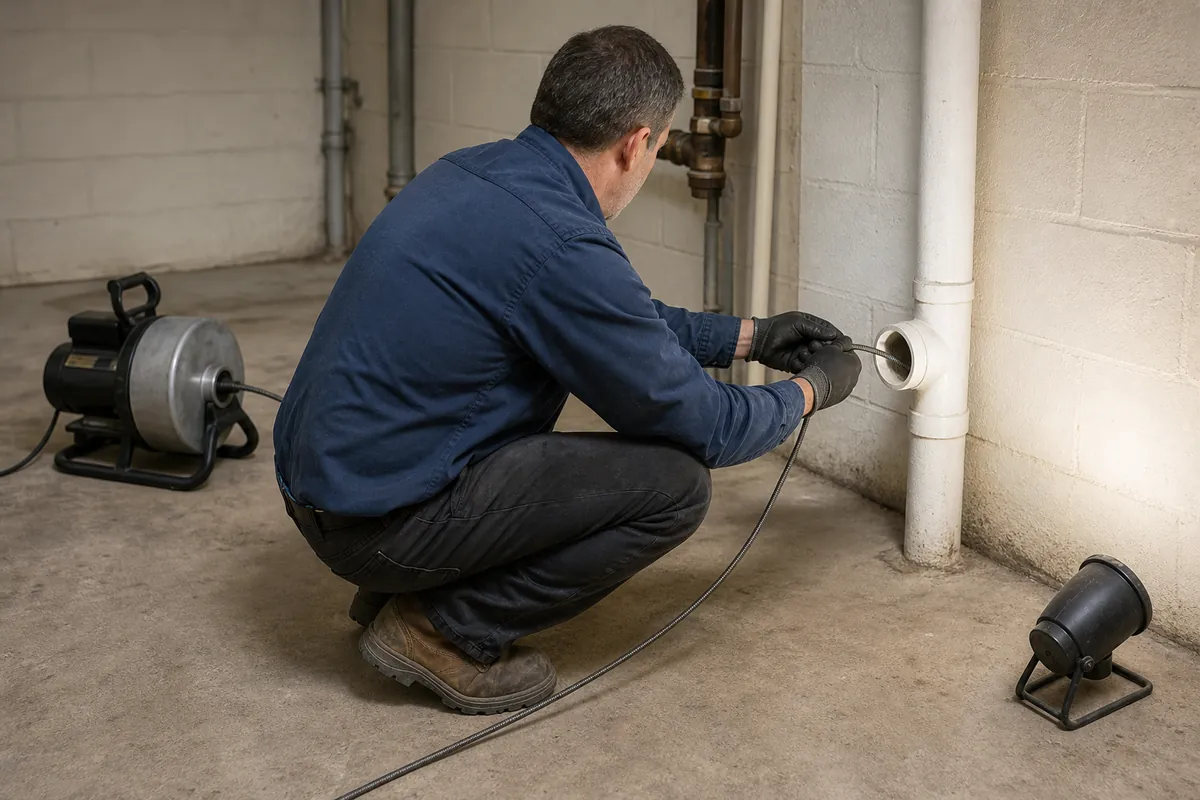
A cleanout is a capped pipe that gives direct access to the main drain. It is often in a basement or crawl space near where the main drain leaves the house, or outside near the foundation. Plumbers use it to clear the line and to run a camera through it.
Finding it before there is a problem saves time on a call. Do not open it while the line is backed up: the wastewater held behind the cap can come out. If it is not obvious where yours is, say so when you call.
When to call, and who
Call when more than one fixture is affected, when a drain is still slow after the simple tries, when the same clog keeps returning, or when anything is coming up that should be going down.
Not sure which one you have?
Describe which fixtures are affected and in what order. That is usually enough to tell where the blockage is.
Common questions
How can I tell if the main sewer line is clogged?
Several fixtures slow or backing up at once, a toilet that gurgles when the washer drains, and water rising in the lowest drain are the usual signs. Any one of them can be a branch problem; several together point to the main.
Why is only my basement drain backing up?
It is the lowest opening on the line, so a blockage downstream pushes wastewater out there first. That is a main-line sign, and it can happen before upstairs fixtures show any trouble. Sewer backup
Is a slow drain an emergency?
One slow drain is not. Sewage coming up, or several drains backing up at once, is. What counts as a plumbing emergency
What makes drains gurgle?
Air moving through water in a trap, which can mean a partly blocked drain or a blocked vent. It matters more if it happens in a different fixture from the one in use.
Should I use a chemical drain cleaner first?
It is best not to, especially if more than one drain is affected. Openers are made for a single fixture's clog, and they leave caustic liquid in the line for whoever has to work on it next.
Related pages
- Drain cleaningSlow or stopped sinks, tubs and floor drains.
- Main sewer line cleaningOpening the line that every branch joins.
- Sewer backupSewage coming up, and whose line it is.
- Clogged toiletFixture blockage or line restriction, and when to call.